· News, CSR and the Environment
The Global Journey of Bukit Asam's Fostered Partner's Jumputan, Reaching as Far as the USA
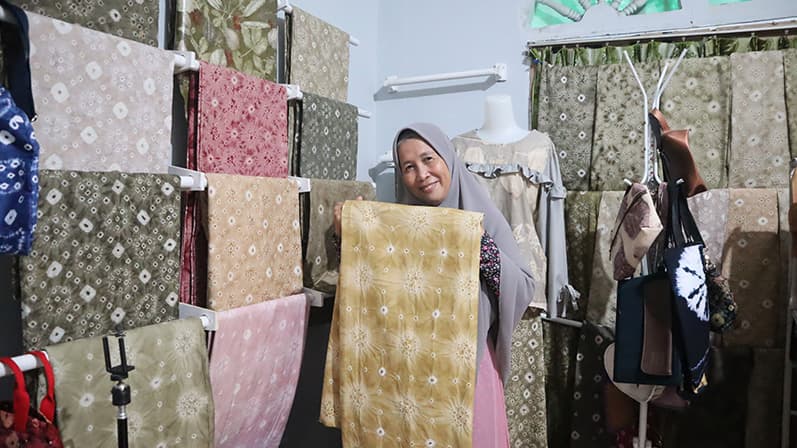
On Thursday, January 30, 2025, Yuniarta Nensy, or Yuni, the owner of Rumah Daun's jumputan business, received a short message via WhatsApp from a government official pursuing a master's degree at Cornell University in New York, United States.
Jumputan is a traditional South Sumatra fabric featuring the distinctive Titik Tujuh pattern. Yuni shared that the sender of the message, a government official, had placed an order for jumputan some time ago to be presented as a souvenir to her lecturer at Cornell University. Yuni smiled upon seeing a photo of her jumputan cloth being displayed as a souvenir in the United States.
"Look, my jumputan cloth has made it to America. A recent Cornell University graduate gave it to her lecturer as a souvenir,” she said.
This wasn’t the first time Yuni’s jumputan had reached the United States. It had previously made its way to San Francisco. Yuni had a friend who helped sell her jumputan in Bali, and one of the buyers was a tourist from the U.S. The tourist later returned home and took a photo wearing a jumputan scarf on the San Francisco Bridge.
“My jumputan has traveled the world,” Yuni said.
Yuni’s work is unique and stands apart from other jumputans. The motif is gradient, resembling the radiant sun. However, Yuni admitted that the glowing pattern was discovered by accident.
“I stumbled upon this motif by chance. It was meant to be opened while still wet, but I accidentally opened it after the fabric had dried. That’s what sets my motif apart. It’s now become a signature feature of my work,” she explained.
Yuni has been in the jumputan business under the Rumah Daun brand since 2022. Prior to that, she created eco-printed fabrics, but they didn’t sell well. At various exhibitions, Yuni noticed a greater demand for local textiles, which led her to try making traditional South Sumatran jumputan cloth.
Creating jumputan cloth is a meticulous process that requires several steps. It begins with selecting the right fabric, sketching the motifs, sewing the ties, preparing the dye, creating the dyes, and finally, the dyeing process itself.
Initially, Yuni was supported by her two children in making the jumputan. Each piece of jumputan cloth measures 3 meters by 1.5 meters, with prices ranging from IDR 600,000 to 700,000. From the very beginning, Yuni has used natural dyes made from ketapang leaves.
“Natural-dyed cloth can never have consistent colors. That’s what makes jumputan unique. The color of each piece is always different. The signature motif is titik tujuh,” said Yuni.
Rumah Daun began to thrive after becoming a fostered partner of PT Bukit Asam Tbk (PTBA) in mid-2022. PTBA provided various forms of support, including PUMK (micro and small business funding) for business capital, raw material purchases, training, marketing, and promotion through exhibitions. “Bukit Asam has supported me from the start of my business and continues to help keep the economy moving,” she said.
Rumah Daun's jumputan production is gaining increasing recognition, with orders flooding in, prompting Yuni to hire more workers. She now employs ten people to assist with tasks such as harvesting leaves for natural dye production, handling administration, and sewing. Additionally, Yuni collaborates with two groups of housewives to create the motif ties.
“In 2022, I was only supported by my two daughters, and there were no tailors at that time. But due to the current high demand, I now work with my friends. I can't manage large orders for premium souvenirs on my own, so I collaborate with others,” she said.
Yuni’s eldest daughter, who has drawing skills, assists with creating the motifs, while her second child, a student in the English program, helps with promotions.
“My first child helps with the drawings, fabric weaving, and administrative tasks. My second child, who is studying English and is a talented presenter, enables us to offer our products at government events in foreign languages,” Yuni said.
Rumah Daun's jumputan cloth is now selling exceptionally well. What began as a modest income of around IDR 700,000 per month in 2022 has grown to approximately IDR 15-20 million per month. “Initially, when I was only selling fabric, my monthly revenue was around IDR 600-700,000. But after I started creating garments, vests, and other items from jumputan cloth, customer demand has significantly increased,” she explained.
Yuni continues to innovate. In addition to selling cloth, she now offers jumputan that has been transformed into clothing, vests, bags, wallets, and more. She consistently explores new natural dyes, refining the fabric’s coloring through numerous experiments, while also enriching the motifs of the jumputan cloth.
"In the future, I aim to create new motifs, such as the pedada flower, a distinctive Palembang design, as well as icons from South Sumatra, like the Ampera Bridge and Kemaro Island. In addition to exploring new motifs, fabric coloring is equally important, which is why we must continue innovating and developing new colors. A key challenge we face is finding natural dyes. Alongside fabric production, I also plan to venture into creating home decor," Yuni said.
In the future, Yuni plans to empower people with disabilities by involving them in jumputan production. 'We will collaborate to support individuals with disabilities who are unemployed. I intend to recruit them,” she said.
The hope is that Rumah Daun will continue to grow, with its jumputan creations reaching global audiences and gaining recognition worldwide. “I was born in Palembang, and there is a personal pride in promoting local textiles. I feel incredibly proud of jumputan,” she said.