· News, CSR and the Environment
Bukit Asam Irrigation Solar Power Plant Has Becomes the Source of Energy for Nanjungan Village Farmers
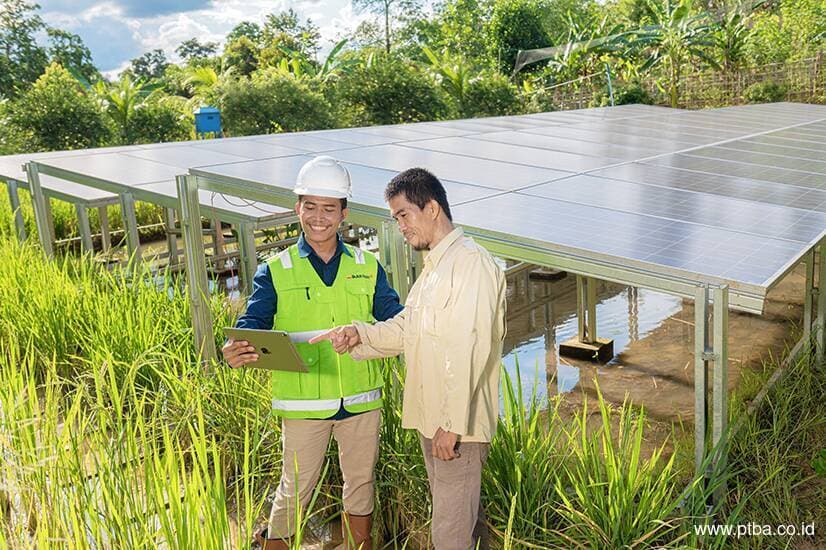
The Solar Power Plant built by PT Bukit Asam Tbk (PTBA) in Nanjungan Village, Lahat Regency, South Sumatra, provides significant benefits for local farmers.
This solar power plant, fully operational since June 2022, has a capacity of 27.5 Kilowatt peak (kWp) and powers the irrigation pumps used to irrigate around 83 hectares of rice fields.
This initiative has significantly increased farmer production by providing a reliable and sustainable source of energy for irrigation needs. With this solar power plant, farmers can carry out irrigation efficiently and effectively, resulting in higher yields and an increase in overall agricultural production.
Head of Nanjungan Village, Depi Satriani, said that farmers in Nanjungan Village can now harvest up to 3 times a year. Previously, farmers relied on rainfed rice fields, which allowed them to harvest only once a year.
"This solar irrigation has benefited 150 people from 8 farmer groups. Agricultural output has increased from one harvest to two or three harvests per year. Farmers are no longer reliant on rain," Depi Satriani explained.
The solar irrigation in Nanjungan Village is one of PTBA's Corporate Social Responsibility (CSR) programs. The irrigation pump used is a submersible type pump which has the ability to suck up water containing mud. The flow capacity of the pump is 50 liters per second with a head of up to 30 meters.
The pump is driven by electricity generated from 100 polycrystaline PV panels with a capacity of 275 Watt peak (Wp) each. The pump draws water from the Lematang River 1.4 kilometers (km) to the reservoir which is then distributed to rice fields.
PT Bukit Asam Tbk (PTBA) VP Sustainability, Hartono, explained that solar irrigation is one of PTBA's efforts to encourage the use of renewable energy, empower communities, while preserving the environment.
Not only building solar irrigation, PTBA also involves and empowers the community to carry out routine maintenance of the equipment. It is envisaged that the equipment given to the community would last for a long time.
"The development of solar irrigation can increase the socio-economic self-sufficiency of the community, and optimize agricultural production. In addition, the use of solar-based renewable energy is one of the efforts in the transformation movement for the use of environmentally friendly energy sources," he said.