· Press Release
PTBA Inaugurates NUSA in Pasir Sakti, Strengthening Community-Based Mangrove Rehabilitation
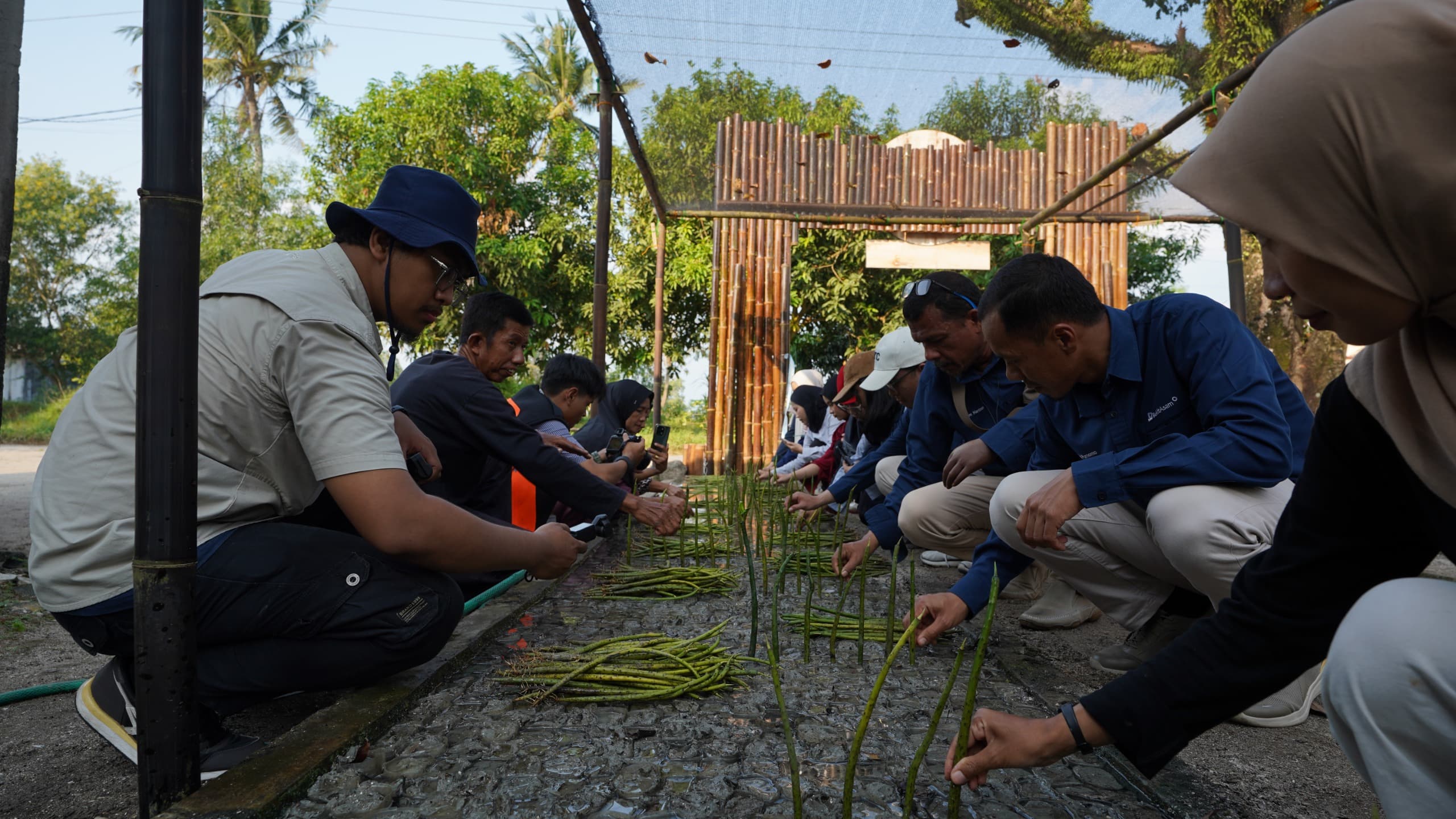
East Lampung, June 29, 2026 – PT Bukit Asam Tbk (PTBA), a member of the MIND ID Mining Industry State-Owned Holding, officially inaugurated NUSA (Nursery Mangrove Unggul Semai Adaptif) in Pulau Waru Hamlet, Purworejo Village, Pasir Sakti District, East Lampung Regency.
Ajis Purnomo, Head of the Sustainable Community Development Section at PTBA, stated that the establishment of NUSA reflects the company's commitment to building a sustainable mangrove rehabilitation ecosystem.
"NUSA is an adaptive mangrove nursery center based on community empowerment that produces high-quality mangrove seedlings using the SAM-SAKTI method, developed and led by Mr. Samsudin. Through this inauguration, we aim to ensure the sustainability of mangrove rehabilitation by providing adaptive seedlings managed collaboratively with local communities," said Ajis.
He explained that Pasir Sakti was selected as the inauguration site because it has become a best-practice model for mangrove rehabilitation through PTBA's collaboration with the Mutiara Hijau I Forest Farmer Group (KTH) and various stakeholders.
"Pasir Sakti has successfully transformed an area severely affected by coastal abrasion into a restored and productive mangrove ecosystem that also generates economic benefits for the local community. The establishment of NUSA further strengthens Pasir Sakti's role as a center for mangrove seedling production and development within the BA-MAXI (Bukit Asam Mangrove Nexus Initiative) ecosystem," he added.
Samsudin, Chairman of the Mutiara Hijau I Forest Farmer Group, explained that the development of the mangrove nursery began in the early 2000s through self-directed learning and knowledge sharing with various partners. Drawing on years of experience, the group has continuously refined nursery techniques that are increasingly adaptive to coastal environmental conditions.
"Today, the nursery is capable of producing approximately 500,000 mangrove seedlings annually, with its highest production reaching 650,000 seedlings per year. Eleven mangrove species are cultivated here, including Rhizophora species such as R. apiculata, R. stylosa, and R. mucronata. We also cultivate Avicennia (locally known as api-api) and Bruguiera (locally known as lacang)," Samsudin explained.
According to Samsudin, one of the key innovations of the SAM-SAKTI method is its nursery system, which utilizes the natural tidal cycle. This approach allows seedlings to receive a continuous natural water supply without manual irrigation, making them more adaptable to field conditions, reducing maintenance requirements, and producing stronger seedlings with higher survival rates when transplanted into rehabilitation sites.
Despite these achievements, he noted that one of the biggest challenges remains securing sufficient market demand for the seedlings. To address this, the group actively builds partnerships with government agencies, businesses, and environmental rehabilitation programs to ensure that its seedling production can be fully utilized.
Through the inauguration of NUSA, PTBA expects to further enhance community-based mangrove nursery capacity, enabling it to support the company's coastal rehabilitation initiatives across Indonesia.
"We hope NUSA will become a center for learning, innovation, and inspiration, encouraging more community groups to work together in protecting Indonesia's coastal ecosystems," Ajis concluded.